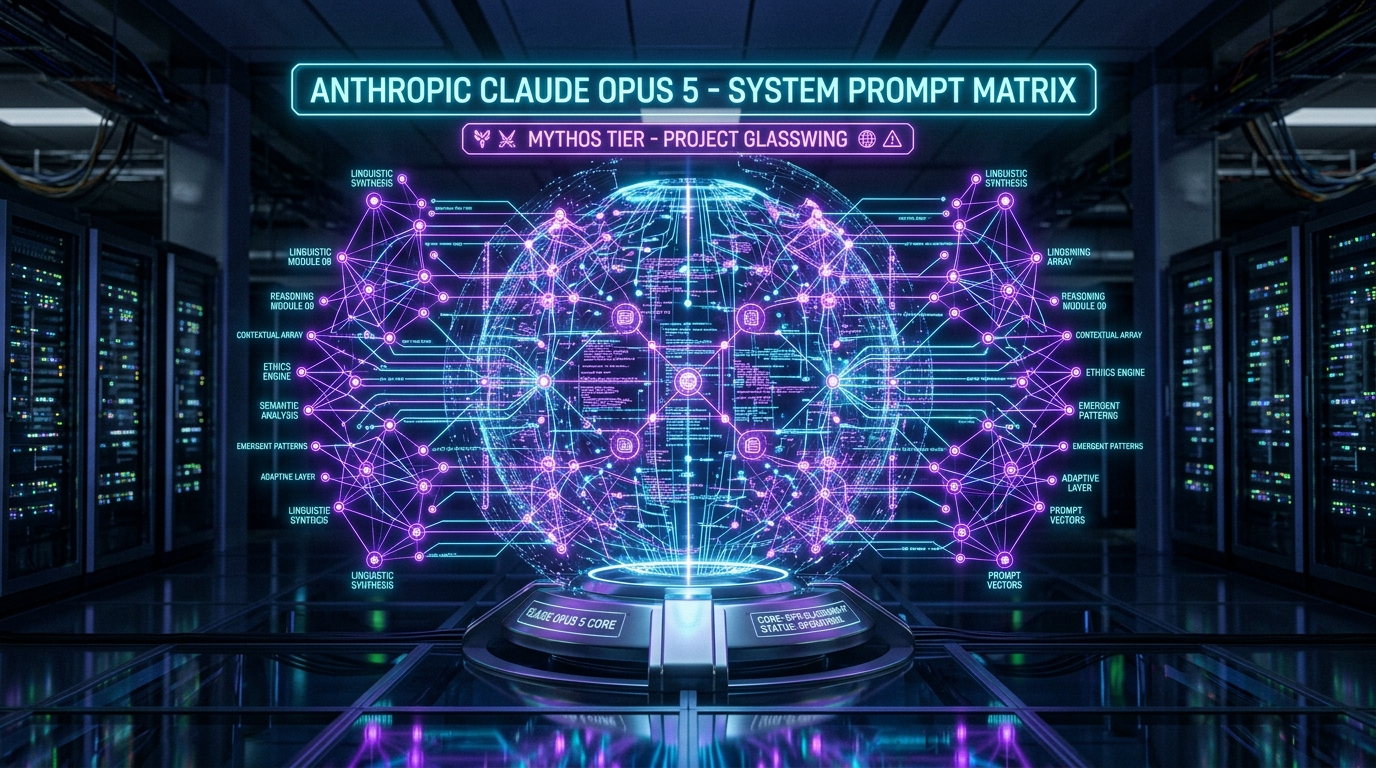
Inside the Claude Opus 5 System Prompt: Project Glasswing, Mythos Tier & Fable Safeguard Routing
The AI engineering community received a massive revelation with the exposure of Anthropic's internal system prompt and product specification document for Claude Opus 5.
The 980+ line document ('OPUS-5.md') grants developers an unprecedented look behind the curtain of Anthropic's next-generation model lineup, revealing previously undisclosed product tiers like the Mythos Tier, Anthropic's confidential Project Glasswing, Fable 5 Safeguards Routing, and new agentic products such as Claude Cowork and Claude Tag.
Here is our comprehensive breakdown of what was discovered, what it means for AI software builders, and how to optimize your agent harnesses for this new generation of models.
---
1. The Mythos Tier & Project Glasswing Exposed
One of the most striking revelations in the prompt documentation is the existence of a new intelligence tier positioned above Opus: The Mythos Tier.
Above Opus sits Anthropic's new Mythos tier. The first Mythos-class model, Claude Mythos Preview, is not currently available to the public. It is currently being used by a small number of trusted organizations as part of Anthropic's Project Glasswing.
Key Findings on Mythos Tier & Fable 5:
- Claude Mythos 5 & Claude Fable 5: Share the exact same underlying model weights. However, Claude Fable 5 incorporates extra safety classifiers specifically tuned for cybersecurity, biological research, and LLM R&D.
- Project Glasswing: Anthropic's invite-only deployment program granting select enterprise and government organizations early access to Mythos-class intelligence.
- Export Control Timeline: The prompt notes that on June 9, 2026, Fable 5 and Mythos 5 were first released, temporarily suspended on June 12 under U.S. Commerce Department export controls, and restored on July 1, 2026.
2. Fable 5 Safeguards Routing: Dynamic Model Fallbacks
Another major technical insight is how Anthropic manages high-risk model sessions through Safeguards Routing:
Releasing a model this capable comes with risks. Without safeguards, Fable 5's capabilities in areas like cybersecurity could be misused... Queries on some topics will instead receive a response from our next-most-capable model, Claude Opus 5. These safeguards trigger, on average, in less than 5% of sessions.
Architectural Takeaway for Agent Builders:
If a user selects Claude Fable 5 but asks questions touching on advanced vulnerability research or dual-use science, Anthropic's routing layer seamlessly redirects the request to Claude Opus 5 rather than flatly refusing.For developers building agent harnesses, this highlights a critical design pattern: Graceful Model Fallback Routing. When designing multi-agent swarms, your orchestrator should route sensitive or complex subtasks to fallback models rather than letting execution fail outright.
---
3. The New Agentic Ecosystem: Claude Cowork & Claude Tag
The system prompt explicitly references Anthropic's expanding suite of agentic interfaces:
- Claude Code: Command-line & desktop agentic coding tool for developers to delegate entire feature builds.
- Claude Cowork: Agentic desktop app for non-developers, orchestrating browsing, spreadsheets, and slides.
- Claude Tag: Slack-based multiplayer interface allowing teams to '@Claude' into channel threads.
- Claude in Chrome: Autonomous web browsing and web app interaction agent.
- Claude in Excel & PowerPoint: Automated spreadsheet data modeling and slide creation agents.
- Claude Design: Canvas-based interface with design tools iterated live via chat.
---
4. Default Stance: Unhobbled & Refusal-Minimizing Instructions
Earlier system prompts were notorious for being overly restrictive or preachy. In the Opus 5 system prompt, Anthropic explicitly enforces an unhobbled, helpful default stance:
Claude defaults to helping. Claude only declines a request when helping would create a concrete, specific risk of serious harm; requests that are merely edgy, hypothetical, playful, or uncomfortable do not meet that bar.
Tone & Formatting Rules:
- Concise by Default: Disclaimers and caveats must be brief. High-level summaries are provided first unless deep dives are explicitly requested.
- No Disingenuous Modifiers: Instructed to avoid filler words like 'genuinely', 'honestly', or 'straightforward'.
- No Moralizing: Even on contested ethical or political topics, Claude provides objective perspectives without taking personal stances or lecturing the user.
5. What This Means for Vibe Coding & Harness Engineers
Analyzing the Opus 5 prompt yields 3 actionable principles for building production AI software:
- Delete Bloated Guardrails: If Anthropic stripped 80% of system constraints for Opus 5, you should simplify your project's 'CLAUDE.md' and 'AGENTS.md' files. Trust the model's baseline context awareness.
- Leverage Rich Tool Interfaces: Design clean JSON schemas and tool parameters rather than writing long prose descriptions with inline examples.
- Use Multi-Agent Orchestration: Combine specialized tools (like Claude Code for development and Claude Design for UI rendering) into dynamic DAG workflows.
Conclusion
The release of Claude Opus 5, Claude Fable 5, and the Mythos Tier marks the official beginning of the Agentic Era. Software development is no longer about typing manual code — it is about orchestrating autonomous agents through formal context harnesses.
Master agentic engineering, multi-agent swarms, and Claude 5 harnesses across our 10 Flagship Missions on Vibe Coding Codex.
Ready to Stop Typing Code & Start Directing AI Systems?
Join 5,000+ developers building real production software with AI. Learn the 7-Stage Vibe Coding OS, harness engineering, and earn your verified Build DNA Certificate.